This post may contain affiliate links. Please read our disclosure policy.
Children now have more options than ever to access math education, thanks to the rapid growth of online learning platforms and continued improvements in in-person classes. However, that means parents have to choose between the two, and it’s not an easy decision. Both options have merits and promise results, but they work in very different ways.

What Does Online Math Tutoring Involve?
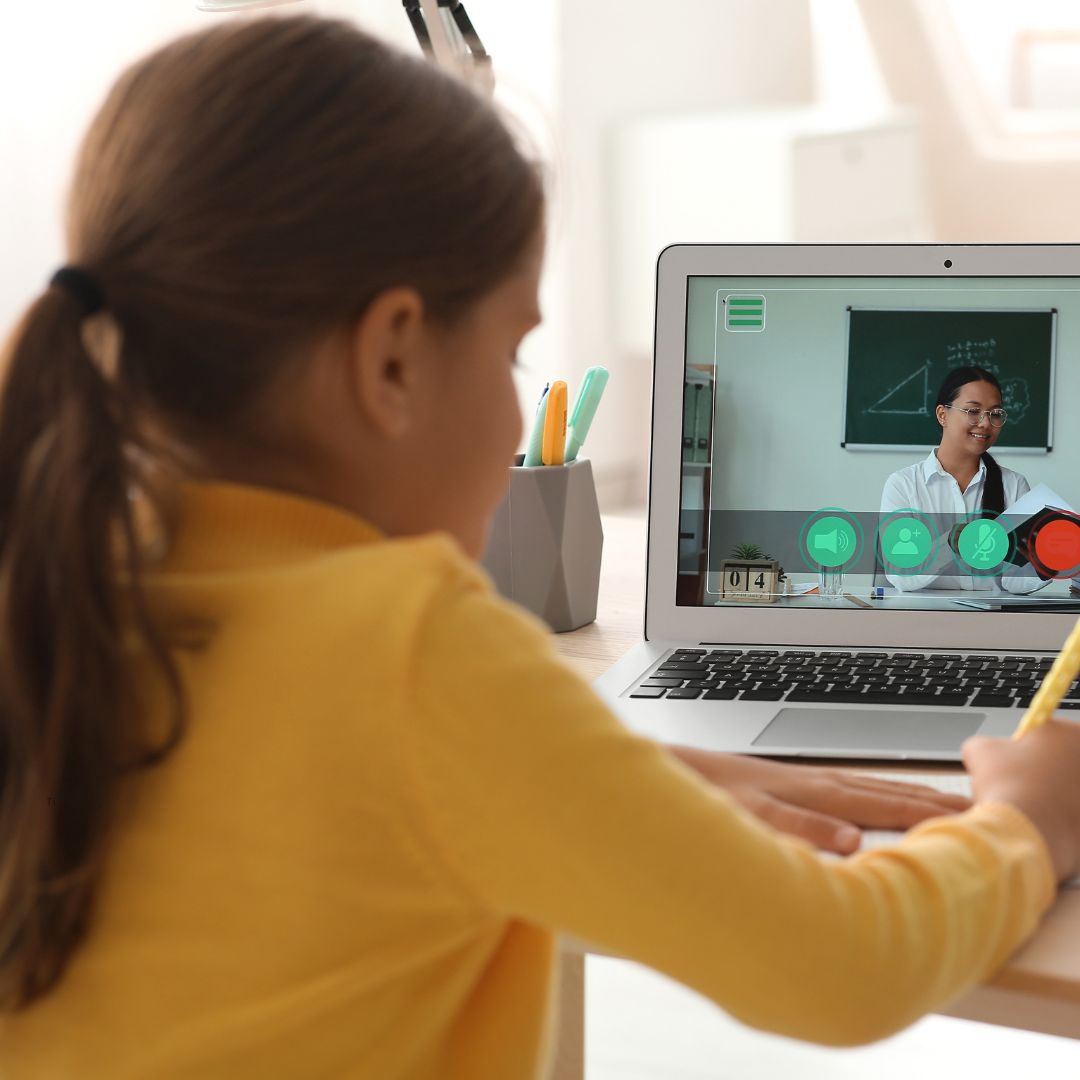
Online tutoring has continued to gain popularity since the COVID-19 pandemic, with the global market expected to reach $21.8 billion by 2030. There are now online tutors for a wide range of subjects, including math. Learning usually takes place through video calls, learning platforms or other interactive digital tools.
Sessions may be one-to-one or held in small groups, depending on the program and your child’s needs. However, it usually focuses on immediate or short-term goals, such as completing homework, preparing for exams, or revisiting concepts your child finds challenging.
What Do In-Person Classes Involve?
In-person math classes offer a more traditional learning experience, where children interact directly with their teacher in a classroom setting. Although private, one-to-one lessons are available, most in-person classes involve learning alongside peers.
These math classes typically follow a structured curriculum to help your kid build skills progressively, so they can fully understand one concept before moving on to the next. In-person classes aim to help your child develop mathematical thinking, logic, and confidence.
How Online Math Tutoring Compares to In-Person Classes
In-person tutoring has long been associated with improved academic achievement. While virtual tutoring is less extensively researched, it can also have a positive effect on learning. Here’s how online math tutoring and in-person classes compare.
Learning Environment
Your child can enjoy learning in familiar surroundings — most often at home — with online math tutoring. For some children, this may help reduce anxiety and make it easier to focus on the lesson. The downside is that studying on a screen can be distracting, especially with digital temptations and household activities.
Since in-person math classes offer a dedicated learning space, your child may be able to switch into “learning mode” more easily. This separation between home and study is crucial when the goal is long-term intellectual development, as a stimulating environment can support better focus and engagement.
Access to Tutors and Resources
Access to a global pool of tutors is one of the advantages of online math tutoring. Many online programs provide advanced digital tools as well, such as virtual whiteboards, interactive exercises, and recorded sessions that students can revisit later.
In-person math classes are more limited by location, so you need to choose from what is available locally. That said, more established institutions usually run these classes with clearly defined teaching standards and oversight. Moreover, the learning method relies less on digital tools and more on discussion and hands-on problem solving, which some students find easier to absorb.
Teacher Interaction
The lack of face-to-face interaction with online math tutoring makes it harder for tutors to pick up on nonverbal cues that signal confusion, distraction, or hesitation in their students. Building rapport and trust can take longer, too, without physical presence. This can affect how comfortable your child feels asking questions.
On the other hand, in-person math classes allow for direct interaction between teacher and student. Teachers can immediately respond to your child’s body language and adjust their teaching approach. Additionally, teachers can give immediate feedback and encourage students to ask questions throughout the lesson. Since there’s a personal connection, your child may feel more supported and understood.
Engagement and Attention Span
Online math tutoring is usually short and focused, using interactive tools like screen sharing, digital games, and virtual whiteboards to make learning engaging and prevent passive screen time. This format works well for some children, but extended screen time may affect attention, particularly in younger learners.
Research has shown that many students report higher engagement and understanding in classroom settings. The discussion, group problem-solving, and active participation in in-person math classes can help maintain your kid’s attention and make learning feel more dynamic.
Social Learning
Online tutoring is usually a one-to-one experience, though you can opt for small virtual groups. This may suit your child if they prefer independent learning, but it limits opportunities for real-time peer interaction.
With in-person math classes, your child has the chance to learn with others their age. Working alongside peers gives them an opportunity to discuss and discover multiple ways to solve a problem. The shared experience may help build confidence and keep learning from being lonely or repetitive.
Flexibility
If your family has a busy schedule, online math tutoring can be easier to manage. You can fit the lessons around school, activities, holidays, or travel, as long as there’s a device and internet access. In contrast, in-person math classes run on set schedules, so there’s less flexibility. However, the routine may help children stay consistent and take their learning seriously.
How to Choose the Best Option for Your Child
The first thing you need to consider is how your child learns best. Do they thrive in a face-to-face setting, or are they comfortable learning on a screen? Hands-on learners often do better in person, while visual and auditory learners may respond well to the interactive tools used in online tutoring.
Next, think about your child’s goal. Are they looking for support with everyday homework or filling gaps in their understanding? Online tutoring can be a flexible option for short-term help and targeted revision. If your child wants to build strong mathematical skills or tackle more advanced topics such as algebra or calculus in depth, in-person learning can offer a more immersive experience. Teachers can guide students step by step, spot misunderstandings early, and motivate them to find clear reasoning for an answer.
Consider consistency and commitment. Online tutoring fits easily into busy schedules, but in-person classes can provide routine, structure, and peer interaction. Ultimately, the best choice is the one that suits your child’s personality, learning style, and long-term academic needs.
High-Quality In-Person Math Education With RSM
The Russian School of Mathematics (RSM) provides an award-winning K-12 after-school math program to help children reach their full potential. Founded in October 1997, it offers multilevel classes for every grade, so your child will be appropriately challenged based on their knowledge and ability. If your child enjoys advanced topics or is interested in elite math competitions, the school also provides a selective and tiered competition program that prepares them for options such as the International Math Contest and the American Invitational Mathematics Examination.
Classes at RSM follow a rigorous curriculum inspired by Eastern European maths education, with a focus on helping children develop logical thinking and problem-solving in addition to mathematical skills. Although tutoring and hybrid or online options are available, classroom learning is the core experience at the school. Lessons take place in small groups to make sure students can focus, discuss, and progress at a steady pace alongside their peers.
You’ll find more than 70 RSM campuses across the U.S., including locations in New York, Massachusetts, Illinois, California, and Washington state. Since each new campus only opens when an experienced teacher is ready to lead it, you can rest assured that the school maintains consistent standards across all locations.
Many families report significant improvements in both grades and confidence. On the competitive side, Team RSM placed sixth out of 150 teams at the Harvard-MIT Math Tournament, and one in four students who took the AMC 8 scored in the top 5%. More than 250,000 alumni have also gone on to attend top universities worldwide.
Choosing the Right Path to Math
Online math tutoring helps fill gaps, and in-person classes help build the foundation. Weigh your options carefully, but if you’re looking for steady progress and lasting mathematical skills, learning in a premier classroom is typically the best choice.